Mostrando entradas con la etiqueta appliance. Mostrar todas las entradas

viernes, 27 de abril de 2018

Coffe Machine Philips HD 5670/A

This seems to be a "mildly old" coffee machine: it has been at my family's home for perhaps 20 years, and I could not find anything on it at internet (besides a complain on a second-hand unit).

It is a bulky unit (almost 30*30*15 cm), which does not use capsules (too modern!): it is a conventional, manual espresso machine. It requires that the granulated and toasted coffee is placed on a cup which is then placed against the steam outlet or grouphead. It also has a separated hot steam supply (the steam wand) for heating the milk (or the water).


Main Parts
The machine has mechanical, hydraulic and electrical parts, in three main systems:
- A pump, which receives (sucks) the water from the water tank and pumps it into a boiler.
- A boiler, which creates pressurized hot steam.
- The electrical controls, with sensors and switches on the other parts.

Besides its very simple control, operation-wise is similar to other coffee machine that I described here.


Schematics
The electrical part is very simple, as indicated in the attached schematics.
The operation is straight: switch S0 starts the machine on/off and the heating resistor (R1), while switch S1 sets the pump in operation (M1), creating the flow of steam. Switch S2 is in parallel to one of the thermal sensors in the boiler (TH4), so it bypasses its function with a kick of additional steam.
The light RD1 (red) is on as soon as the machine is connected (S0), and the light OR1 (orange) is on when the heating resistor is active.

The Pump
The pump is model CS M3637 from Eaton, Mod CP2, with a power of 70 W working at 25-60ºC. It is of the vibrating or solenoid type, described in another post. (Eaton is a giant, and it seems they do not manufacture these pumps anymore; there are a number of internet sites on these pumps and spares: one example here). It is mounted on rubber pads, and it is protected with a thermal fuse (Microtemp 4204A ZKAFZ 98 C; TH2) attached to the body of the pump. (Here on the operation and coding of these thermal fuses, although this one seems to be older).

The Boiler
Made in, in two pieces, bolted (th boiler in aluminium, the grouphead in inox). There is no mark on it. It has a release valve, manually regulated for the steam wand.


The heating resistor (R1) has approx. 43 ohm, which yields a power of some 1,150 W at 220 V (rated 1,260 W).
There are three temperature sensors in contact with the body: two switches from Campini TY60 T180 (TH3 and TH4), and one thermal fuse Microtemp 4300A ZHAHG 152 C (TH1).
(I'm curious about the two thermal switches and the temperature distribution in the boiler, but I have not yet a thermal camera!)
Here on the operation and coding of the thermal fuse, although this one also seems to be older; and here on the specifications of the Campini thermostat switch (“single pole thermostat with snap-action disc”).


The Switches
The three switches are mechanical, of the push type, normally open, with one pole. The manufacturer is ROLD, series CM. S0 and S1 are model E1026 A1 (they retain the closed position when pushed); Switch S2 is model E2015 A1 (does not retain the position when pushed).
ROLD is an Italian manufacturer, a “leader in the manufacture of components for household appliances”. Their webpage does not have catalogues.


sábado, 7 de abril de 2018

Toaster Kenwood TTP102

I found this toaster a couple of weeks ago, with the main cord cut: here is the “disemboweling”!

The Toaster
The manual is here (from ManualsLib).
It is a simple, 2 slice toaster, with "600-800 W", vertical positioning and some controls which I’ll describe later.
It seems to be out of sale in some places (Amazon-UK, Amazon-DE, Kenwood-DE, Kenwood-PAK, Kenwood-ES) but it is available elsewhere (IND, UK, MasterSparesOnline, PAK, ebay-DE).


The Operation
The device is relatively simple, with 5 “controls”:
- the slice lowering lever,
- the variable "browning control",
- the cancel, defrost and reheat buttons (illuminated).


The Inside
The electrical parts are organized in 4 elements:
- the power switch, with a solenoid,
- the variable resistor (“browning control”),
- the 3 heating panels, and
- the control PCB (with the cancel, defrost and reheat buttons and the timers).

The following pictures show the sequence of opening the toaster.


There seems to be a market of spares for this unit, mostly in the UK (PartMaster, 4Kenwood, BuySpares, eSpares).


The Power Switch and Solenoid
Lowering the slices with the main lever closes a switch, that feeds a solenoid. The lever is then attracted to the solenoid and when the power supply to the solenoid is open, a spring in the lever makes it jump-up, with the slices.

The solenoid is labelled “TA8018”. It is fed from the control board, which supplies it with DC current.
The switch is mounted on a board, with no fuse.


The Variable Resistor
It is a linear variable resistor, labelled “B200K” and I have measured from 300 to 200 kohm. One of the bands on the sides of the support is conductive, the other resistive.


The Heating Panels
There are three heating panels, connected in series. One of them is connected with a single wire to the control board.


I have measured about 25 ohm for the ones on the sides, and 30 ohm in the central one. The heating power is therefore 600 W at 220 V (not 800 W).
Based on the length of the wire, the unit resistivity is approx. 150 ohm/m.
The support is a sort of micaceous paper.
The panels are labelled “TA8018M”.


The Control Board
The control board is connected to:
- the power switch for line,
- the end of the wire at the first heating panel for “neutral”,
- the solenoid, and
- the variable resistor (the “browning control”).


The board supports three push buttons with light, but its core is a chip: TN0841B2 A0201D, which I described here.
The board is labelled as “TA8018GS-D-11”, "E123995", "KB-3151" and “2006-7-15 REV:A”, for which I have not found any reference.


The schematics is as follows:
At the connector:
- 1 is for the "ground" at the heater,
- 2 and 4 are for the solenoid, and 
- 3 is for the AC line.

(The pins of the chip are not correctly identified).


domingo, 23 de julio de 2017

Microwave Oven Daewoo

A Daewoo Microwave Oven
In a previous page I have reviewed in some detail a microwave oven (Teka MW170).
I have found at home the electrical parts of another microwave oven, whose origin I do not remember, likely recollected from some street. It seems of the Daewoo brand.

I will review here the electrical parts, referring to the previous page for the common elements.

Wiring Diagram
The wiring diagram that I have prepared from the parts and the circuit is this one:

The diagram is incomplete as the timer/power motors are missing, but the connectors are there.


Parts
Power Source
While the Teka 170 had just a fuse, this one has a filter unit for high frequencies.
The board is labelled DWLF-M13 SS.

The fuse is rated 15 A at 250 V.
R1 is 1.5 Mohm
C1 is a film capacitor from Pilkor, box shaped, PCX2 335M MKP, with 100 nF, tolerance class M.
C2 and C3 are labelled "NW 222 MX1Y2", ceramic capacitors for interference filtering (X1Y2), 2.2 nF and tolerance class M.
No clue about L1...

Switches
S1, S3: from Gersun, GSM V1603A2, 16 A at 250 VAC, SPST NO,
S2: from Starion, SZM V16-FA-61, 16 A at 250 VAC, SPDT.
S4: from Starion, SZM V16-FA-63, 16 A at 250 VAC, SPST NO.

Thermal Swiches
Labelled:
- TH1: NT101 KTE, N1CO 90 5331
- TH2: NT101 KTE, N65 75 5324.
I have no information on where they were installed. From the wiring diagram it seems TH2 is on on the magnetron, the other in the oven's food compartment.


Turn-table Motor
Synchronous motor from GPS Corp. 5-6 rpm, 3-2.5 W, 220-240 V. Model ST-16 MN73MQAD.
Daewoo sees to use them frequently (f.eg. here).


Fan Motor
Motor shaded pole, with no references.
The motor was covered in grease, so either the ventilation was crappy, or the users of the oven were doing heavy cooking...

(Sorry, the plate was under the grease! Manufactured by Daewoo Electronics Corp. Label: "MV10CA, M02, 230 V 50 Hz,  0.28 A max, Z.P. B Class").
The motor runs an axial fan (on the Teka it was a centrifugal fan). Impeller diam. 11 cm.

Timer and Power Switch
The mechanism (motor) activating the timer is not in the parts that I have, just the geared switch and selector. 
One of the switches (TIM1) is normally off, and is set on when the time selector is moved from its zero position.
The function of the other switch (POW1) is unclear to me.


Transformer Feed
The power supply to the transformer is regulated by a small board, whose main element is a relay.
The board is labelled as "DWSR 1".

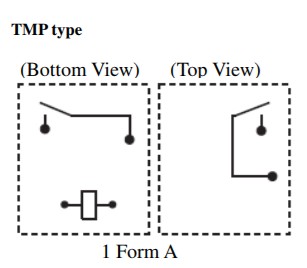
The relay, from Texcell, is model KH, contact arrangement 11 (form A, SPST-NO), termination TMP (for PCB), E-24H. Specifications are likely similar to these ones
It is unclear to me the operation of this relay. The model seems out of manufacture, and I have not found direct references to it. As per one catalog from Texcell for similar relays,  the schematics would be:

Based on this, the scheme of the regulating relay would be:
 
Transformer, Capacitor and Magnetron
The transformer is from Daewoo Electronics Copr., with no indication of ratings (230 V, 50 Hz, Class 220, R1S80).


The HV capacitor has a capacity of 0.98 uF, rated at 2100 V, with an internal resistor of 10 MOhm.
The diode is marked "C1 01" (or, perhaps, "1010").
The fuse is marked as: " 5 kV, 550 mA".


Finally, the magnetron is from Daewoo, 2M218 50323AN JF.